
Wildlife tourism seems like an ambivalent term. If it’s wild and free, how can you “tour” it? Added to that, the recent headlines that show how people are willing to go to lengths to take selfies with animals and kill them are startling. Where does responsible wildlife tourism begin? What’s the blurry line between enjoying the beauty of wildlife and taking it for granted?
Wildlife Tourism Definition
In the simplest sense, wildlife tourism is a sustainable and eco-friendly way to interact with animals in their natural habitat. An integral part of several tourism initiatives across the world, it seeks to engage with wild animals in a non-invasive manner. Often these are divided into consumptive and non-consumptive practices depending on human behaviour and how we exploit the animals. Often as tourists, we are unaware of the pain we are causing to the animals and continue repeating the same vicious cycle. False marketing on the part of the advertisers too, often blinds us to the suffering of the animals.
Here are a few ways in which we are persisting to torture animals (albeit unknowingly):
The Selfie Fever:
This one needs no introduction. In the quest for a selfie, over the last couple of months a baby dolphin and swan have perished. The baby dolphin was pulled out of the sea and passed around tourists for a selfie. Soon, due to lack of oxygen and heat, the baby dolphin died. Same story with the swan. And there are several other such selfie-crazed stories that don’t quite make it to the headline. Taking a selfie is not fun for the animals, they are not meant to pose as props for self glorification on social media!
Petting/Feeding:
Contrary to popular belief, wild animals do not like being pet/fed. In fact, such behaviour disrupts their normal breeding and feeding patterns that can lead to illness or stress. Most places keep the animals in tight enclosures with fixed tiny portions of food and are not aiding in the conservation program at all! These animals are snatched from their mothers at a young age and vigorously trained to be docile for “safe” interaction.As they grow up, they cannot even be released into the wild as the upbringing has stripped them of natural wild instincts. These animals remain captive for the rest of their life. The only profit anyone is getting from such an enterprise are the owners who charge exorbitant fees for such practices.

(C)One Green Planet
Elephant rides:
Elephants already have the short end of the stick due to poaching for their ivory and elephant rides double their misery. For the tourist’s 15 minutes of “fun”, the elephant is trained at a young age by separating them from their mothers and keeping them enclosed in tight cages. They are tied with ropes and tortured in order to respond to specific commands and move only when instructed. This is a formal process known as “crushing”.
Update: The death of a female elephant used for tourist rides, at the Angkor temples in Cambodia has caused a stir in the tourism industry. You can sign this Change.org petition to support the end of this horrific practice.
Dolphin/Whale shows:
The smartest mammals of the world and some of the largest mammals of the world join together to perform paltry tricks like jumping through a hoop to entertain massive crowds. What the crowd does not know, is that the behind the clapping and fame, lies a sinister story of exploitation. Bred captive or chased down by speed boats, these oceanic wild life beauties spend the rest of their lives in a home that’s the size of a swimming pool cleaned with chlorine. No respite from the sun or familiar natural landmarks like corals, these highly developed “echolocation” swimmers- the same skill we replicate for SONAR navigation technology, are caged by concrete walls in return for measly portions of food. Often these whales/dolphins die due to stress when being transferred from the wild due to the high level of suffering!
Antics at Sea World (C) Trip Advisor
Monkey Dance:
A common sight in some places, the plight of these monkeys are beyond words. With ringed handcuffs and no food, these monkeys are forced to dance for money and beaten when they do not. The owners too themselves are often impoverished and the monkeys do not get food/rest in hopes of earnings. Walking several kilometres in scorching heat with no water and shows on repeat, these monkeys entertain the viewer but live in utter misery.
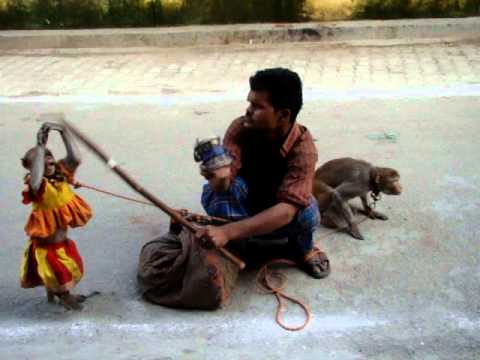
Dance for food. Maybe.
Snake Charmers and Kissing Cobras:
Another street entertainment favourite, Thailand has upped the quotient by allowing tourists to kiss cobras. And how can humans come in such close contact with poisonous cobras? You guessed it right. Their fangs are removed with metal pliers and venom ducts are blocked-often resulting in painful infections.
Bear Parks/Crocodile Farms:
A lot worse than conditions in terrible zoos, these places are overcrowded and caged with concrete floors. Harnesses for their skin, the crocodile is used for fashion accessories and the bears are made to perform circus tricks in exchange for food.
Of course, awareness has increased these days and several countries ban poaching, hunting, animals in circuses and even capturing dolphins for wild life themed parks. But this is not enough. Atrocities against animals continues till date and perpetuates in insidious manners. Our compassion and humanity must not just extend to fellow humans but also other beings. In order to understand/interact with the marvels of wildlife, there is no need to destroy or sabotage their beauty! Wildlife conservation and welfare must go hand in hand in order to increase quality of life- since the goal is not just quantity.
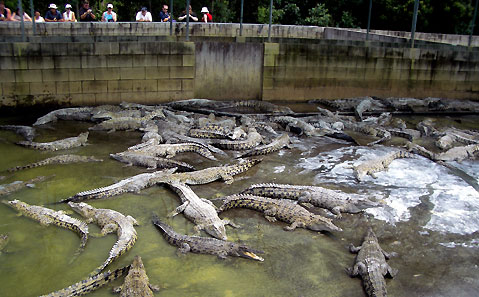
A crocodile farm in Australia
Practices like the ones mentioned above parade as conservation tactics but do little for the animal’s welfare. The amount of stress and suffering involved has adverse impact on the animal as well as the larger eco system it is involved in. The privatization of such establishments have made it a business-model which harvests animals only for monetary value.
Contrary to that, national parks, sanctuaries and biosphere reserve serve as a good example of wildlife tourism. A great example of how national parks work is the famed Project Tiger. The aim was not just to conserve tigers, but also the micro organisms that support soil that support trees that support herbivores that ultimately support tigers and provide healthy competition and balance. A national park, through State ownership aims to conserve all facets of the habitat of the targeted animal. The flora and fauna automatically are conserved in a bid to maintain balance and mutual benefit. Human intervention is restricted and monitored. Blessed with a diverse country, India has over 50 national parks working simultaneously that focus on several animals. Here is a list of 8 that you must definitely put on your Itch List!
And how do you play your part in this process? By your support! Whether zoo, or national park, your choices affect the economy and the policy making process. Hence it is necessary that the choices we make are informed and impact our environment in a sustainable manner. Yay or Nay? Let us know what you are thinking in the comment section!

“…The baby dolphin was pulled out of the sea and passed around tourists for a selfie. Soon, due to lack of oxygen and heat, the baby dolphin died”
I just wanted to add that I have read that the dolphin was already dead, and had washed to the shore along with a few others. Wasn’t sure how true this was, thought you might not have seen it.
Source:
http://metro.co.uk/2016/02/19/apparently-that-dolphin-wasnt-killed-by-tourists-taking-selfies-5705566/
Hey Pete!
Thank you for this. However I am aware that the accuracy of this is debatable. While most news reported the death due to over exposure to heat and dehydration (Daily Mail, The Sun,CNN and several others) only Metro talks about prior death. Out of sheer majority, we chose to go with this news. But the larger point is not about whether selfies were taken before or after death.To have an argument like that in the first place would be proof of inhumanity.